
Death of Keith Porter Jr. Raises Questions About ICE Use of Force
The killing of Keith Porter Jr., a U.S. citizen fatally shot by an off-duty ICE agent in Los Angeles, has drawn renewed scrutiny to federal immigration enforcement, use of force, and accountability nationwide.
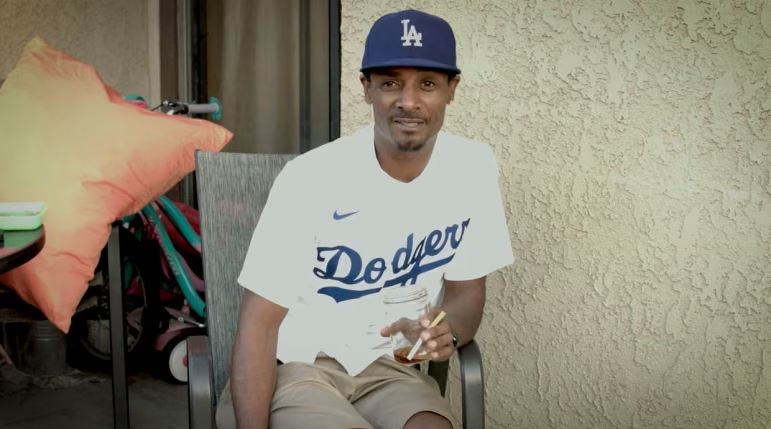
The death of Keith Porter Jr. did not make national headlines, but for his family and community, it remains a painful reminder of the often-unacknowledged human cost of Immigration and Customs Enforcement operations.
Porter, a 43-year-old father and U.S. citizen, was fatally shot outside his home by an off-duty ICE agent on Dec. 31, 2025, in Los Angeles. His cousin, Jsané Tyler, described him as loving and joyful.
“When he walked in, he brought joy. He always had a laugh, a joke, a smile,” Tyler said.
Porter’s mother, Franceola Armstrong, spoke at a vigil following his death, describing her son as her greatest joy.
“He was a joy to be around,” she said. “My son had the biggest heart… sympathetic, appreciative, full of gratitude.”
Authorities have not publicly released details about the status of the investigation into Porter’s death. It remains unclear whether the ICE agent involved has been placed on administrative leave or referred for independent review.
Porter’s death is one of several in recent months tied to ICE operations. While some cases have drawn national attention, others have received little public scrutiny. Across the country, activists are calling for greater transparency, accountability and justice.
In Los Angeles, civic leader and Black Lives Matter Los Angeles co-founder Melina Abdullah has been at the forefront of advocacy efforts surrounding Porter’s death. Abdullah said, citing family members, that Porter had been celebrating New Year’s Eve inside his home when he stepped outside and fired a celebratory shot into the air.
According to Abdullah, an ICE agent who lived in the same apartment complex put on tactical gear, returned outside and shot Porter in front of his home.
Abdullah said local authorities have remained largely silent, offering Porter’s family “nothing” in terms of answers or action.
“The community is going to have to mobilize,” Abdullah said, emphasizing the need to pressure elected officials and law enforcement agencies to demand accountability.
Porter’s death comes amid heightened national scrutiny of ICE’s use of force. One week later, Renee Nicole Good, a 37-year-old U.S. citizen, was fatally shot by an ICE agent in Minneapolis on Jan. 7 during mass federal immigration operations in the Twin Cities.
In Minnesota, Good’s death intensified debates about federal enforcement in residential neighborhoods and community safety. Her killing sparked protests in Minneapolis and across the country, with thousands gathering downtown in the days following the shooting.
Minneapolis continues to grapple with the trauma of the 2020 police murder of George Floyd. Good was killed just a few blocks from the site where Floyd died, reopening wounds in a city still confronting the legacy of police violence and systemic injustice.
Civil rights attorney Nekima Levy Armstrong said the deaths of Porter, Good and others reflect a broader pattern tied to ICE operations nationwide. She described ICE’s tactics as aggressive and said the lack of accountability has left many communities fearful.
“Individuals whose lives have been taken by ICE represent a pattern of lawlessness,” Armstrong said.
She noted that ICE agents often operate with military-style equipment, including flashbang grenades, tear gas and other chemical agents, which can make neighborhoods feel unsafe.
Armstrong also pointed to deaths that occur out of public view, particularly inside detention facilities. During an unofficial congressional hearing held by U.S. House Democrats in St. Paul on Jan. 16, U.S. Rep. Pramila Jayapal of Washington said ICE reported 35 deaths in detention facilities. The highest number in two decades.
Beyond physical harm, Armstrong emphasized the emotional and psychological toll ICE operations take on families and communities.
“This isn’t just an immigration issue,” she said. “It’s a law enforcement issue. It’s an issue of constitutional law, and it’s a community safety issue.”
For Porter’s family, national conversations offer little comfort. Loved ones say they are still waiting for answers about why lethal force was used and why the ICE agent involved has not been publicly identified. Currently, the family is pushing for an investigation.
Tyler said her cousin should not be remembered only for how he died, but for how he lived.
“He brought people together,” she said. “His presence filled rooms and made people feel seen.”
Since Porter’s death, family members and community advocates have gathered at vigils and memorials calling for accountability. Advocates say the case raises serious questions about how ICE agents operate while off duty and the scope of authority they are granted.
As national conversations about ICE operations continue, advocates argue that meaningful oversight must follow. Without transparency and accountability, families, particularly in Black and marginalized communities, remain left with fear and unanswered questions.
Lizzy Nyoike is a Hubbard School of Journalism & Mass Communication student.