

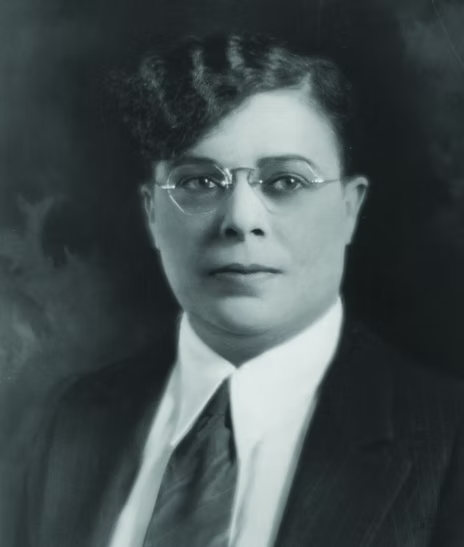
A Minneapolis street along the Mississippi River has been renamed Lena Smith Boulevard to honor Lena Olive Smith, Minnesota’s first Black female attorney and longtime civil rights advocate.
The street, formerly known as Edmund Boulevard and named for segregationist developer Edmund Walton, is part of a broader effort to confront systemic racism in the city’s history and spaces.
The renaming follows a five-year, community-driven initiative called Reclaiming Edmund Boulevard, founded in 2020 by Joe Larsen and Mark Brandt. The pair said the project was inspired by Minneapolis’ reckoning with racial inequality after the murder of George Floyd.
“Edmund Boulevard was never a reflection of our shared values,” one committee member said. “Reclaiming it allows us to replace a name rooted in exclusion with one grounded in justice and belonging.”
Walton, the original street’s namesake, had used racially restrictive covenants to prevent Black families and other people of color from buying homes in Minneapolis. The impact of these covenants has been documented by the Mapping Prejudice Project, which highlights how segregation shaped neighborhoods across the city.
As the effort gained momentum, organizers realized that simply removing Walton’s name was not enough. They wanted to replace it with a name carrying intention and meaning. In 2024, a nine-member naming committee was formed to recommend a replacement, ensuring diverse voices were included.
“We recognized that the core group was primarily white,” said Kristen Eddy, a committee member. “We felt responsible to try to correct a historic wrong, but we worried we were in an echo chamber, so we broadened our outreach.”
The committee required that any final name recommendation be unanimous. Criteria included a connection to Minneapolis, ties to racial justice or community repair, and the ability to inspire learning. After community input, Lena Olive Smith emerged as the clear choice. Nearly 600 residents participated in the public survey.
Born in 1885, Smith became Minnesota’s first Black female lawyer in 1921. She served as president of the Minneapolis NAACP, fought against police brutality, and defended Black homeowners facing racial intimidation. Her work preceded the Civil Rights Movement by decades.
“Lena Smith challenges us to see our city in a fuller, more honest light,” the Reclaiming Edmund Boulevard committee said.
The initiative prioritized community engagement throughout the process. Organizers partnered with the Longfellow Community Council, Council Member Aurin Chowdhury’s Ward 12 office, local schools, churches, and neighborhood groups.
“We wanted this process to be inclusive and community-driven,” Eddy said. “As neighbors working to address a legacy of racial exclusion, we made it a priority to listen and connect across communities.”
After the City Council approved the change in 2024, the committee continued supporting residents by holding drop-in sessions to help update mailing addresses and other documentation.
“Symbols matter,” Eddy said. “It’s a signal to all our community members: You belong here.”
For Larsen and Brandt, the renaming represents a broader movement to confront racial inequalities in housing and history. “What began as an effort to remove a name misaligned with our community’s values grew into an opportunity to educate and uplift powerful figures from underrepresented groups in our local history,” they said.
Eddy reflected on the personal lessons learned during the process. “I learned something new about myself during this process: that urgency can be a form of oppression,” she said.
Now, Lena Smith’s name stands not just as memory, but as presence, direction, and a way forward, inviting residents to learn her story and understand that the fight for justice in Minneapolis extends across generations.
Lizzy Nyoike is a Hubbard School of Journalism & Mass Communication student with interest in community stories, investigative and multimedia journalism.