
By Charles Hallman
Staff Writer
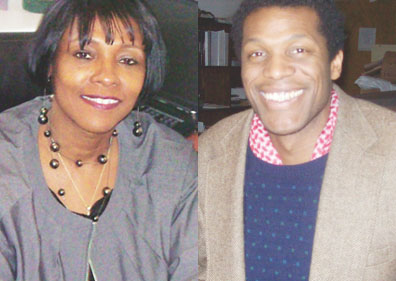
(r) Racial equity report card’s author Jermaine Toney, lead analyst for Organizing Apprenticeship Projects
(l) St. Paul’s DFL State Representative Rena Moran
-photos by Charles Hallman
Racial equity must be incorporated in solving the state’s budget deficit and “not as an add-on,” say multi-racial leaders and community members.
“Some people say that because of tough economic times, racial equity needs to take a back seat,” said State Representative Rena Moran (DFL-St. Paul) during a February 25 press conference at the State Capitol where the Organizing Apprenticeship Project (OAP) unveiled its annual Legislative Report Card as well as a statewide “proactive” racial equity agenda.
“This isn’t just the right thing to do [or] the smart thing to do,” Ramsey County Commissioner Toni Carter said inside the Capitol rotunda during an OAP-sponsored morning rally.
The OAP previously have released four racial equity report cards on the state legislature’s and governor’s performance on supporting policies to promote opportunity and racial equity.
“Over the years, I’ve heard some of you call the report card the Bible on racial and public policy in the state,” joked OAP Lead Analyst Jermaine Toney, who authored the organization’s racial equity report card, which points out that the stark racial disparities that exist in Minnesota, including closing the achievement gap, health, wealth, jobs and justice, must be addressed.
This year’s OAP report card also included a five-year review (2005-2010). Among its key findings: An average of 15 percent of all racial equity bills gets passed into state law, and during 2007-2010 legislative districts with less than 40 percent constituents of color showed some of the strongest support for racial equity bills.
“We find that leadership on issues of racial equity moved forward even in a bipartisan state government, tough economic times and rapid demographic shifts,” explained Toney.
Rep. Jeff Hayden (DFL-Mpls.) was one of 12 representatives and eight senators who earned an “A” — a total of 104 lawmakers were recognized by OAP for their racial justice work. The second-term lawmaker said he appreciated the honor but wished the entire state legislature made the grade “and not just a select few of us to get this award. We got to do better and work harder — we still have racial inequities throughout the state,” he surmised.
During the 2010 legislative session, lawmakers and the governor earned an overall B grade — eight of 12 bills that the OAP studied were passed into law including:
• Expanding child care opportunity to close education gap for young mothers.
• Protecting renters in foreclosed properties.
• Preventing racial predatory mortgage lending.
• Banning “the box” (asking about arrests or a criminal record on an application) on statewide public employment.
• Improving health inequities by untangling information by race and language
• Boosting funding for special education.
• Promoting hiring equity in green jobs.
A bill to establish a poverty task force also was signed into law, added Toney. “This task force will recommend institutional practices and policies that assist women, people of color [and] low-income people to create and sustain wealth through business opportunities, educational opportunities and training.”
However, among the bills that later were vetoed by former Governor Tim Pawlenty included expanding expungement reform for youth criminal records, lifting restrictions to employment in human services, and a bonding bill that would provide funds for the proposed Black museum and cultural center.
The OAP’s Proactive Racial Equity Agenda also was introduced last week at the State Capitol. According to Toney, it was generated after discussions with organizations such as ISAIAH, a faith-based group, and other community leaders.
“It is time for us in this state to really begin to lead toward racial equity, not just have it as an add-on but how we engage on communities, and do our hiring and how education happens,” said Rev. Paul Slack, pastor of New Creation Church in Brooklyn Park, and ISAIAH clergy and religious leaders’ caucus co-chair.
“It’s time for change,” said Rev. Billy Russell, senior pastor of Greater Friendship Missionary Baptist Church, who is also an ISAIAH member.
Toney says that job creation is a top priority: “Unemployment knows no boundaries in the state — it’s in rural areas, in the suburbs and in the cities.” However, the jobless rate among Blacks and Latinos in Minnesota “is two-to-three times higher than the state average and even higher for women of color,” he asserted.
The OAP agenda’s other key points include:
• Economic growth — tie public investments to strategies that directly address racial and economic inequities, and support policies that build wealth and livability of neighborhoods.
• Education equity — make a commitment at the state level to increase racial and economic equity in the public education system.
• Criminal justice — reduce racial disparities in the juvenile justice system, and adopt policies to build opportunities for those with criminal records to re-enter the community and find meaningful employment and education, and restore their voting rights.
Bad economic times often caused more hardship on communities of color, which make up over 16 percent of the state’s population. However, Toney pointed out that the state lawmakers can’t ignore this in addressing the budget deficit. “Today’s challenges are big but not unsolvable,” he believes.
With the 2011 legislative session now underway, this year’s OAP report card and racial equity agenda is “timely” as state lawmakers are making decisions for the next two years, which could have a positive or a negative impact on communities of color in Minnesota.
“We are going to be heard,” concluded Toney.
For more information on the 2005-2010 Legislative Report and the Proactive Community Agenda, go to OAP’s website at www.oaproject.org.
Charles Hallman welcomes reader responses to challman@spokesman-record er.com.