
By Elizabeth Ellis
Contributing Writer
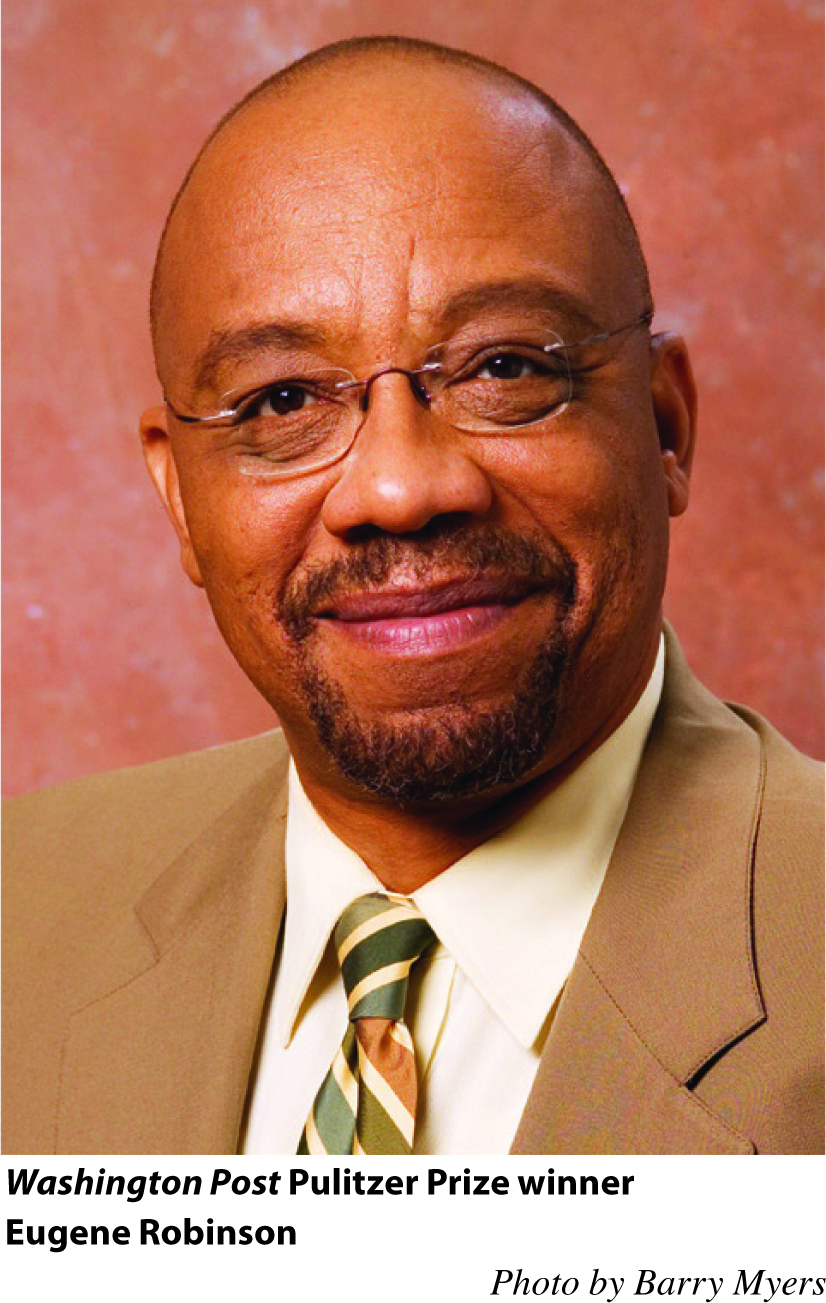
Eugene Robinson, a Pulitzer Prize winner for his Washington Post newspaper election coverage of President Obama and a National Association of Black Journalists member, spoke at House of Hope Church in St. Paul this past January, courtesy of the Weyerhaeuser Foundation.
If Rev. Dr. Martin Luther King, Jr. were still alive today Robinson believes King would “still agitate, still fight;” that King was a “moral force who changed a nation forever, who represented the conscience of the nation; that King would say, “Push on,” and that even advanced age “would not prevent him from holding feet to the fire, from holding folk accountable. “
He also believed that King (“Absolutely!”) would still have been an activist for economic justice. “After all, jobs and freedom was what the March on Washington, D.C., 1963, was all about. Equality and opportunity was the focus.” Robinson believes it is “Immoral and mistaken” to ignore the poor, “to write off that many people. We don’t see ’em or we won’t look. The precipitous decline in crime takes poverty off the front pages. They’re under-reported. The longer we wait, the worse it will be.”
He recommended the audience “Go to the new Reverend King memorial in Washington, D.C., and feel what I feel. I’m an optimist. I go there, I say, ‘Thanks.’” The memorial is near the Tidal Basin on a beeline between the Jefferson and Lincoln monuments and is “one of the most powerful and popular” sites there. He spoke of how this “symbol embraces the possibilities.”
He said, “I nearly ran into a politician there at the memorial. We disagree on just about everything, but I think he was genuinely moved. We could agree that Reverend King belonged there.”
“Jim Crow did not go gently,” Robinson said. In his native South Carolina, Robinson was an eyewitness youngster to a student demonstration, the events of which were impetus to his career as a journalist. It seems the “All Star Lanes” bowling alley was segregated and for three nights students demonstrated.
However, it was his father’s stern reprimand, “Get down!” when Robinson went to the window to peek out at the goings on that shocked him. His father was a soft spoken man. He’d never heard him raise his voice before. Outside 300-400 yards from his house were a dozen highway patrol cars armed with rifles pointed at a house where it was believed SNCC activist Cleveland Sellers was staying.
It was claimed after, but never proven, that shots “were fired on” law enforcement officers by protestors and as a result three protestors were shot dead, some with shots in the back and in the soles of their feet. Later, as a college freshman in 1970, Robinson wrote about this incident and was encouraged to enter his essay into a contest. His essay won.
Robinson believes that although “racism is an aberration,” things have changed. However, “racism is something we can’t and don’t talk about. There are things we should be doing that are not getting done.”
He talked about how the home he bought in Arlington, VA, was redlined. He saw the restrictive covenant with his own eyes. It read, “Do not sell to Blacks, Jews, or drunks.”
He said the education in his hometown was “highly unequal” between Blacks and Whites.
He told how his family drove from South Carolina north to Ann Arbor, MI to visit his paternal grandparents and how he couldn’t understand why the car was packed like a settler’s horse-drawn wagon with enough provisions to last three weeks. “We couldn’t stop for food in a restaurant. My father wouldn’t even stop for bathroom breaks in a gas station unless he knew ahead of time it was safe. Didn’t want to get caught. And not after dark. We could only stop in a Black-owned hotel.
“When we crossed the Ohio border my father would always stop, and I was delighted to get out and run to a playground. I was not allowed to use the playground in South Carolina. Don’t lose sight of how far we’ve come.”
Robinson told the audience how tickled he was to call his mom and “cackle” when the news of the late infamous segregationist Senator Strom Thurmond’s Black daughter broke, but mom said, “We thought you knew.” Mom knew from her position as librarian at the college Thurmond’s daughter attended. He emphasized that the only time he ever heard a curse inside his family’s Christian home was when his grandmother would refer to the man as, “That damn Strom Thurmond!”
When asked about President Obama’s legacy, he cited “being the first Black president, of course,” as well as his healthcare reform law and “avoiding the second Great Depression.” Robinson sees the camera footage of the First Family walking across the White House lawn to climb in to the helicopter as most heartening.
Robinson believes there’s a remedy for Washington if “somehow [we could] take the influence of money out of politics. It’s worse than corrosive. I’m a cynic on campaign reform.”
He considers that the current use of the filibuster rule in the Senate “was not what the planners had in mind, was not the original intent. There’s been a huge increase in use. It used to be a rarity. Now it’s used to block everything.
“You learn issues out here” in Washington, D.C., he added. “They’re always changing. We kind’a get it right sometimes. I’m always surprised by how many intelligent, well-meaning folks there are in D.C., most with good motives, even if they don’t always keep them.”
Elizabeth Ellis welcomes reader responses to ellisea51@hotmail.com.