

The Racial and Ethnic Approaches to Community Health (REACH) program, funded by The Centers for Disease Control and Prevention (CDC), aims to improve the health of Black people — and other residents of color — in Minneapolis by addressing two key issues: chronic disease prevention and vaccinations. Jennie Meinz leads the chronic disease prevention efforts, focusing on nutrition and physical activity, while Luisa Pessoa-Brandao oversees vaccination initiatives.
The REACH Program is slated to end in 2028, which — amidst current DEI trajectory changes following the executive orders of President Trump — has raised concerns about the future of federal funding.
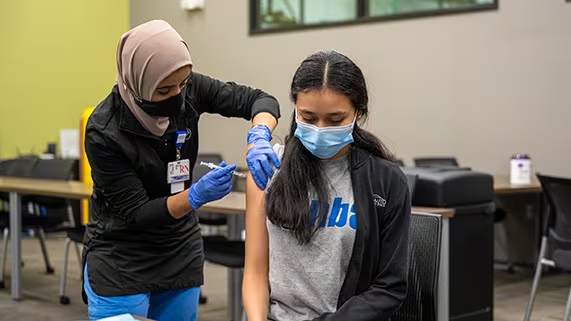
In 2024 alone, the program delivered 1,775 vaccinations — including 635 flu, 582 Mpox, 518 Covid-19, 22 Tdap, and 18 MMR vaccines — across 87 clinics and 73 outreach events. These outreach efforts were key in reaching communities and educating over 1,800 people about preventative care.
“We’re excited to move projects from our design and assessment phase to full implementation,” said Pessoa-Brandao. “However, there’s some uncertainty around the amount of federal funding that we may continue to receive in the coming years.”
Minneapolis was awarded $1 million in 2023, and $900,000 in 2024, under the REACH grant. However, funding for the next three years remains uncertain with expected reductions, especially for vaccine efforts. This uncertainty has raised concerns, particularly as the program relies heavily on funding to support staff and community initiatives. Currently, REACH funds six full-time positions split between both chronic disease prevention and vaccination efforts.
Meinz echoed Pessoa-Brandao’s concerns, stating, “Years three, four and five are a little uncertain. We typically get our funding announcement in September, and we do anticipate further reductions in the vaccination area.”
Beneficiaries of CDC grant funding were instructed to end support for diversity programs due to President Trump’s Executive Orders. It remains unclear whether the REACH program will be impacted by these directives.
“We are monitoring the decisions and litigation at the federal level. It’s too early to speculate on what will happen to our funding,” said Scott Wasserman, communications manager for the city’s public health department.

Despite these challenges, the REACH program has made significant strides in improving access to healthy foods, promoting physical activity, and offering breastfeeding support. Through its nutrition efforts, the program has partnered with BrightSide Produce and the Native American Community Clinic to deliver fresh produce to patients experiencing food insecurity or chronic disease. Since September 2023, 184 patients have participated in this initiative, and the program plans to expand to five clinics and/or hospitals by 2028.
“Our doorstep delivery of fresh produce is impactful because it simultaneously addresses both food security and public health by providing clients with a reliable source of fresh, healthy food,” said Justa Heinen-Kay, co-director of BrightSide Produce. “Our doorstep delivery overcomes barriers like transportation and limited hours at food shelves.”
Southside Community Health Services and the People’s Center Clinics and Services also collaborate in delivering produce prescriptions.

To promote physical activity, the REACH program has partnered with the Native Youth Artist Collective to design and install 10 wayfinding signs along key streets in the Little Earth neighborhood. These signs, designed by youth artists, aim to improve pedestrian safety and encourage physical activity while representing local culture.
Breastfeeding support is another central component of the program. Through collaborations with the Cultural Wellness Center and the Division of Indian Work, REACH is working to improve breastfeeding rates in Native American and Black communities.
The program aims to train at least 35 health care providers in hospitals and clinics by 2028, and establish at least five lactation-friendly health care sites in Minneapolis by 2028. Recent data from the Community and Child Health Study indicates that Black infants are breastfed for shorter periods compared to Hispanic infants.
According to the latest U.S. National Immunization Survey, only 66% of Black mothers initiated breastfeeding in 2012, compared with 83% of white mothers and 82% of Hispanic mothers. At six months, only 35% of Black mothers were still breastfeeding, compared to 55% of white mothers and 51% of Hispanic mothers. Despite this, efforts to promote breastfeeding have helped narrow the gap over the years.
The REACH program also benefits from partnerships with organizations like the Fairview Health System, which launched a Food Resource Navigator position in June 2024 at Riverside Clinic to help connect patients to food assistance programs like “Market Bucks,” a part of the Farmers Market Nutrition Program. To date, 103 patient consultations have been made, with 161 referrals to food assistance programs.
While uncertainties about future funding persist, the REACH program remains committed to its mission. “Our goal is to create sustainable, long-term improvements to the health of Minneapolis’ Black and Native American communities,” said Meinz. “While federal funding may fluctuate, we are exploring additional sources of support to ensure the continued success of these initiatives.”
Council Member Robin Wonsley of Ward 2, whose district is home to a culturally diverse student base, expressed her enthusiasm about the REACH grant’s impact. “People in recent years have really gotten excited about how to bring art hand-in-hand together,” she said. “I know there’s been, at least throughout my tenure, some resistance around linking those two. It’s innovative work.”
Council Member Jeremiah Ellison of Ward 5 also applauded the efforts of the REACH program, acknowledging the challenges faced by those working in health disparities. “I want to acknowledge that you guys are doing this in the context of a lot of misinformation and uncertainty,” Ellison said.
“I never thought we’d be in a situation where this kind of work would have a little bit of an existential threat to it.” Ellison continued: “I want to acknowledge you guys are doing an incredible job,” he paused. “We need this work more than ever, as people, I don’t know, are eating more bare meat and raw milk, or whatever.”
Clint Combs is a contributor to the Minnesota Spokesman-Recorder. Find him on Twitter @Combs0294. You can also send Combs news tips on the Signal app @Combs0294.