
‘612’ film premier reveals how
“This didn’t start in 2020,” said filmmaker Diem Van Groth. “That was just the eruption. But the fire was burning way before.”
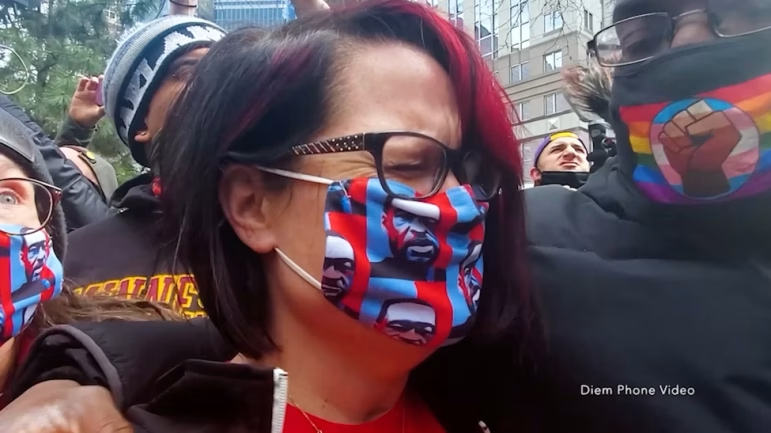
On May 23, Groth’s debut feature-length documentary “612: Darkness in the Land of Nice” will premiere at Justice Page Middle School Auditorium in Minneapolis. The film explores the historic youth-led uprising that followed the murder of George Floyd, and the deeper roots of systemic injustice in Minnesota and across the country.
“The 612 is about the post-9/11 generation in Minnesota,” Groth said. “The young people who, after decades of inequities, created the largest single-issue protest in modern history.”

Groth started filming on the streets of Minneapolis the night the George Floyd video went viral. “It was a Monday. That evening the video surfaced, and by that night people started watching,” he said. “The next day I was at the Third Precinct just like a lot of Twin Cities residents. That was the first time that Minnesotans — just regular citizens — confronted the cops.”
He hadn’t planned to make a film. But after filming consistently throughout the summer of 2020, Groth said he “didn’t stop asking questions.” What he uncovered led him to connect decades of underdevelopment in North Minneapolis to a legacy of racist urban planning, redlining and displacement.
“When I got back here, I was like, wait a minute. North Minneapolis looks the same as it was when I was a kid,” Groth said. “How come there’s no shopping on Broadway? No sit-down restaurant on Plymouth? I just started asking a lot of questions.”
Groth, who spent much of his adult life in Los Angeles, had returned home just before the pandemic due to his mother’s illness. “Had my mom not gotten sick, I would’ve been living my bougie life in Santa Monica,” he said.
Instead, he became embedded in development projects on West Broadway and North Commons Park, eventually serving as a strategic advisor for Reconnect Rondo’s Land Bridge in St. Paul.

“I did not know that Rondo and South Minneapolis were Black communities that had freeways run through them,” he said. “I started realizing there are 9,200 other Black communities that had the same thing happen. Every major city where you have a freeway, those freeways literally went and destroyed every Black and brown community in the country.”
Groth began connecting those revelations to the broader myth of “Minnesota Nice.”
“It’s been whitewashed under this idea of progressiveness,” he said. “But Minnesota is the best place for the majority, and literally the worst place for the minority.”
The murder of George Floyd, in his words, “just exploded all of it.” The film doesn’t focus solely on the pain. It highlights how youth led, organized and resisted.
“These young people saw these inequities because they were living through it,” Groth said. “When they saw a Black man die for nine minutes and 29 seconds, it wasn’t just about race. It became a coalition of young people — LGBTQ, Native American, Muslim, Jewish — who realized, ‘If they’re doing that to you, they’ll do it to me too.’”
He emphasized that the majority of early protesters were high school and college students, many of them allies. “People thought those kids would stop after a few days. But they stayed on the streets. They shut the city down,” Groth said. “That was the moment I knew: this isn’t just about mourning. It’s about organizing.”
Groth said the film depicts how the media got it wrong. “The media was saying these were people burning the city — BLM and Antifa. I was on the ground filming. And the misconception was huge,” he said. “The truth is, it was classmates of those Black youth. It was a rainbow coalition. And that’s what made it so powerful.”
The film also lifts up solutions. “I could’ve made a protest film, or a film about George Floyd. But that’s not what I wanted to do. I love Minnesota. I love Black people. So I said, ‘Let’s make a film about the solutions.’”
Groth chose to spotlight four organizations: the Reconnect Rondo, V3 Sports, Black Men Teach, and the Page Education Foundation.
Marvin Anderson, board chair of ReConnect Rondo, said the land bridge is a vision rooted in justice. “Our neighborhood was cleaved apart in the name of progress when I-94 cut through Rondo,” he said. “This land bridge gives us the chance to physically and culturally reconnect our community.”

Anderson believes the project can become a national blueprint. “It’s about more than paving over a highway,” he said. “It’s repairing relationships, economic pipelines, and generational wealth. We want Rondo to become a model for other displaced Black neighborhoods.”
He also stressed the importance of intergenerational leadership. “This movement needs both elders and youth,” Anderson said. “Elders carry the memory. Youth carry the momentum. When we walk together, real transformation becomes possible.”
That same principle of legacy and forward motion lives in the classroom. The film highlights the work of Black Men Teach, a Twin Cities-based nonprofit increasing the presence of Black male educators in elementary schools. Its executive director, Markus Flynn, believes education is the most powerful entry point for long-term change.
“We cannot talk about liberation without starting in the classroom,” Flynn said. “Education is the foundation of everything. It’s where we plant the seeds of self-worth and possibility.”

Flynn explained that placing Black men in teaching roles disrupts harmful narratives and reintroduces Blackness into the learning space as a symbol of knowledge and leadership.
“Our kids — and our communities — need to see Black men as thinkers, mentors and scholars,” he said. “We’re not just entertainers or athletes. We are engaged, intellectual, and deeply invested in the future.”
Black Men Teach not only recruits educators but builds sustainable pipelines to keep them in the profession through mentoring, institutional partnerships, and community support.
“If we want different outcomes, we need different inputs,” Flynn said. “That starts with who’s leading our classrooms and how students are being empowered to see themselves as agents of change.”
V3 Sports and Page Education Foundation were not available for comment.
Still, Groth said much of the progress promised in 2020 has yet to materialize. “There were a lot of promises made. And almost every promise — broken,” he said.
“But you know who’s not scared? Youth. The young people are not scared. And they’re going to vote. They’re going to remember their power.”
He says he hopes the film will do more than spark emotion — that it will also spark action.
“If you want to see how Minnesota youth changed the world, be in those seats at 7 pm on May 23,” Groth said. “Because this is a celebration of Black people, and a celebration of what’s going right.”
“612: Darkness in the Land of Nice” premieres Friday, May 23, 2025, at 7 pm at Justice Page Middle School Auditorium, 1 W. 49th St., Minneapolis. Tickets are available on a sliding scale from $0 to $100. A producers panel and community discussion will follow the screening.
For more information, visit www.612film.com.
Kiara Williams welcomes reader responses at kwilliams@spokesman-recorder.com.