
Dr. Brittany Lewis on Building a New Table: A Challenge to Institutions That Keep Missing the Dial
Dr. Brittany Lewis, founder and CEO of Research in Action, has written a book challenging institutions, funders and those in positions of power to move beyond good intentions and build a new model of community engagement rooted in shared power, accountability and failing well.

As a Minnesota native, Dr. Brittany Lewis admits she is deeply invested in the innovative change the Twin Cities represent and in the numerous possibilities the cities offer. However, the cities, and the state itself, struggle with performative action from activist organizations and powerful institutions. These actors don’t serve the communities they intend to help, and as Dr. Lewis explains in the introductory chapter of her book, the disconnection is harmful. Living inside this contradiction, Dr. Lewis writes about ways to address and alter the traditional research process and how to close the gap between communities and researchers.
The phrase “building a new table” represents the reconstruction of who gets a seat at the table and who has been historically left out. Dr. Lewis mentioned Shirley Chisholm, the first Black congresswoman, who famously coined the phrase, “If they don’t give you a seat at the table, bring a folding chair.” At the time, it was revolutionary for a Black woman to assert that kind of agency. However, Dr. Lewis suggests that it is now important to encourage communities to operate by their own systems. “We don’t want to bring a folding chair to someone else’s table, we want to build a whole new table,” she states. “We aren’t coming to your table.”
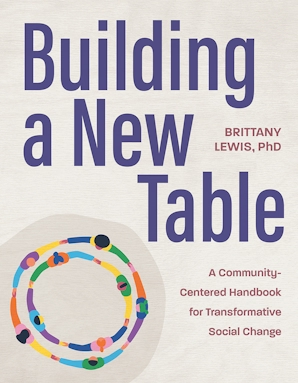
Dr. Lewis states in her book the importance of failing well and recovering during the journey to shifting research models. The throughline of her book is that the change people seek is centered around the development of self-awareness. “Failing well is making a commitment to lean into discomfort,” she writes. “Knowing when to show up for change, and when to step back and when to step forward.” She encourages readers to analyze what is apparent in their bodies during difficult conversations and to examine their interpersonal growth as active community members. Dr. Lewis explains how these considerations are crucial to becoming a reliable part of the reconstruction process.
To Dr. Lewis, failing well means existing in a supportive ecosystem where mistakes are allowed. A system that lives far beyond strategic outcomes and policy and starts with people and their capacity to grow. She hones in on the importance of constructive feedback rather than shame, noting that it is rare in professional spaces for people to discuss the difference. “What does it mean to be part of an ecosystem that will hold you, not shame you?” is a question Dr. Lewis recommends readers ask themselves.
One of the main themes of Dr. Lewis’ book is how institutions can shift from performative action to genuine leadership. Something she argues cannot be achieved without understanding the value of sharing power. “How do you relinquish power, and still be an important part of that ecosystem?” Institutions and organizations must ask themselves this question and reevaluate their strategies with the understanding that those they want to serve may have solutions that differ from their original plans. She believes this work must come before engaging with communities, as many institutions act without their guidance, making communities passive actors in their own betterment. Breaking down this paternalistic mindset, she argues, is step one. While Minnesota is known for its well-meaning humanitarian politics, Dr. Lewis encourages readers and policymakers to think beyond good intentions. “What can I do with ‘well-meaning’?” she asks. Within the book, institutional and personal accountability is a central concept, and readers should expect to self-reflect and ask how they, too, might be part of the problem.
Dr. Lewis explains that one of the hardest parts of shifting from traditional research models is rejecting “objectivity.” She argues that the notion of what is objective, academically factual and efficient has been historically defined by white cisgender men, scholars who tend to position themselves as neutral without recognizing the power dynamics they have created. Not only is the normalization of this narrative rejected in her book, but throughout her life’s work. Creating space specifically for queer Black women to redefine objectivity is one of Dr. Lewis’ driving motivations.
Dr. Lewis’ Equity in Action model challenges the existing framework for executing social change. She explains how the model is constrained by capitalism and, to combat this, she “asks the person with the biggest pocketbook to leave the table.”
She makes clear that this book is not written for impacted community members, who have already lived the experience. It is intended for investors, funders and those in positions of power who are exerting that power through institutional action and “missing the dial.” “This is for the well-meaning person who claims they want to do better but keeps missing the dial,” she says. Dr. Lewis hopes readers finish the book understanding that there are many paths to success. “People will try to tell you there is only one way… don’t believe them. I will show you ten.”
Dr. Lewis has risen through the ranks and achieved success across many different corners of her life. As a former college professor, Minneapolis Federal Reserve Bank scholar-in-residence and founder and CEO of Research in Action, she has become a decorated, sought-after leader. Her book echoes the importance of transparency, accountability and the discarding of ego in order to create authentic social change in community spaces.
For more information, visit https://www.upress.umn.edu/9781517919450/building-a-new-table/.
Destiny Kromah is a Macalester college student and contributing writer for the Minnesota Spokesman-Recorder