
A Tale of Two Minnesotas: Black Academics Assess Where Black Communities Stand and Where They Are Headed
Contributing writer Noah Riccardi speaks with Macalester College history professor Dr. Walter Greason and author and educator Dr. Artika Tyner about the last fifty years for Black communities in Minnesota and across the country, the durable structural barriers that remain and what the next decade will require to move toward equity and justice.
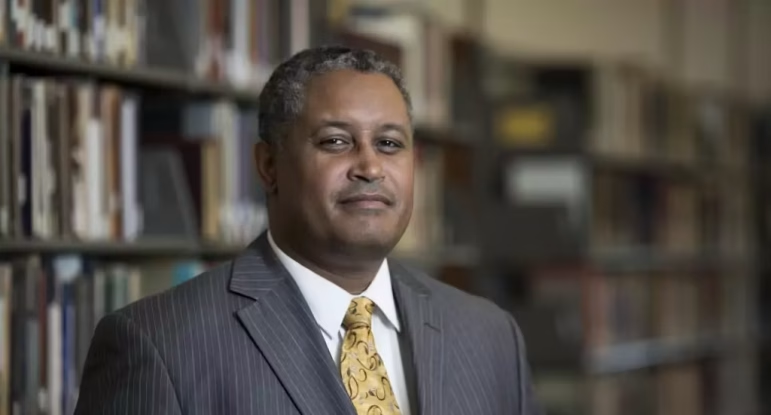
Where do Black communities in Minnesota and across the country stand today, and where are they headed? The Minnesota Spokesman-Recorder reached out to prominent Black academics to get their assessment. Looking back across the last several decades and forward to the next ten years, their responses were sobering, nuanced, and at times hopeful.
Dr. Walter Greason, a professor of history at Macalester College, cautioned against an overly optimistic view.
“There is a temptation to see the last fifty years through rose-tinted lenses due to the increasing levels of political participation and elected leadership for Black communities,” Dr. Greason said. “However, the realities that the core of Black middle class has been decimated and the increasing levels of carceral policy have reduced the opportunities for success in Black communities, especially since 2017.”
Dr. Artika Tyner, an author and educator who takes a data-based approach to sociology, arrived at a similar conclusion.
“In the past 50 years, technological advancement, broader access to higher education, and increased visibility of Black leadership across sectors have reshaped opportunity in meaningful ways,” Dr. Tyner said. “At the same time, structural barriers have proven remarkably durable. Racial wealth gaps persist with a projection of over two centuries to bridge. According to Goldman Sachs, ‘The median Black household owns nearly 90% less wealth than the median white household.'”
When asked about the last 25 years, Dr. Greason pointed to the impact of international politics on Black communities within the United States.
“The rise of the United States as the world’s lone superpower has been disastrous for Black people,” Dr. Greason said. “Most of the leverage that the Civil Rights Movement had was based on the foreign policy of the U.S. to appear superior to the Soviet Union. In the wake of September 11, the foreign policy of the War on Terrorism combined with the expansion of the prison-industrial complex to destroy Black communities, especially in the Midwest. While educational gains were remarkable, the resistance of the private sector to invest equitably in Black communities places hard limits on the possibilities of equal opportunity nationwide.”
Dr. Tyner also emphasized how disparities in the justice and education systems continue to impede progress.
“Educational disparities remain entrenched with over five million Black children struggling to read,” Dr. Tyner said. “The criminal justice system continues to disproportionately impact the Black community… Black youth are nearly five times as likely as their white peers to be held in a juvenile facility.”

While some progress has been made, change has been slow and has yet to dismantle the major systemic barriers facing Black communities, particularly in education and the criminal justice system.
Minnesota is far from free of those barriers.
“For many, Minnesota represents the land of milk and honey, as evidenced by high quality-of-life rankings, strong educational outcomes, and economic prosperity,” Dr. Tyner said. “Yet for Black Minnesotans, the data tells a completely different story. The state consistently ranks among the worst nationally for racial disparities. Black communities face some of the widest gaps in educational achievement, household income, and criminal justice involvement. Minnesota’s narrative is not unique from the nation at large, but the disparities here are often more pronounced, creating what many describe as a tale of two Minnesotas.”
Dr. Greason also noted significant disparities in Minnesota while pointing out that the state fares somewhat better than its Midwestern peers.
“For the first time, there is a coordinated effort to understand the specific histories of the Black Midwest,” Dr. Greason said. “These efforts hold enormous promise to reverse the devastating waves of deindustrialization that crippled Black communities from Cleveland to the Twin Cities. In Minnesota, there has not been enough effort to raise the standard of education for all students, especially Black students in the metropolitan area. Greater investment in hospitals, schools, and new small businesses would achieve the vision of a strong, equitable, and inclusive Minnesota. We are in a much better position than Ohio, Michigan, Wisconsin, and Iowa. Only Illinois has a similar path to widespread success.”
Looking ahead, both professors offered a mix of apprehension and optimism about the next ten years.
“Afrofuturism has emerged as a powerful cultural force that is shaping new institutions around the world,” Dr. Greason said. “My optimism is that Black communities will grow stronger in connection with the African continent, Asian markets, and the European Union. On the other hand, the vulnerability of most Black communities across the southern U.S. will become more entrenched.”
Dr. Tyner struck a note of both urgency and possibility.
“The next decade presents a choice,” Dr. Tyner said. “Progress is not inevitable. It is a conscious choice evident by daily action. Change will depend on leadership and strategic action. The path forward requires training the next generation of leaders to think critically, build sustainable solutions, and pursue justice with intention. The next ten years offer an opportunity to build new inroads to justice and freedom within our own communities, one step and one decision at a time. This is an investment of your time, treasure, and talent. How will you plant a seed of social change?”
Noah Riccardi is a recent Macalester College graduate and contributing writer for the Minnesota Spokesman-Recorder.