
Karmelo Anthony, Diamond Reynolds and the Marvina Haynes Act: Three Stories, One Through Line of Racial Injustice
MSR editor Jasmine McBride connects the 35-year sentence handed to 19-year-old Karmelo Anthony in Texas, Diamond Reynolds's decade of unacknowledged trauma following Philando Castile's murder and the fight for the Marvina Haynes Act at the Minnesota Capitol, tracing a through line of racial injustice and calling on systems to invest in repair.
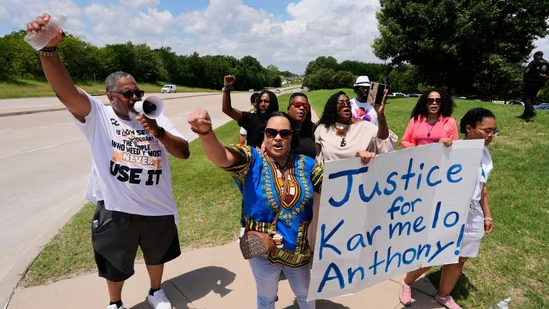
On June 9, 2026, a Collin County, Texas jury sentenced 19-year-old Karmelo Anthony to 35 years in prison for the murder of 17-year-old Austin Metcalf, a white student fatally stabbed during a high school track meet in Frisco in April 2025. The verdict, reached in less than three hours by a jury that was not adequately diverse, sent shockwaves through communities already questioning whether equal justice exists for Black Americans.
Anthony, who was 17 at the time, maintained he acted in self-defense after Metcalf repeatedly confronted and physically pushed him. The jury rejected both a self-defense claim and a “sudden passion” finding that could have reduced the sentence. His mother, Kayla Hayes, was the sole witness during sentencing, pleading for mercy.
The day after, both parents broke their silence.
“My son is no murderer,” Hayes said. “My son didn’t intend to hurt anyone. My son was defending himself. And that’s what hurt so bad.”
His father, Andrew Anthony, said the verdict felt predetermined. “He was convicted when he walked out of the jail. It was not innocent until proven guilty… he was already guilty.” Both parents described ongoing death threats and called the trial fundamentally flawed. They plan to appeal.
The racial dimensions are impossible to ignore. None of the 12 jurors were Black. The state struck three potential Black jurors during selection, citing their profession as educators. The defense objected; the judge allowed the strikes. Critics have raised Batson challenge concerns, pointing to the Supreme Court’s ruling that lawyers cannot use peremptory challenges solely based on race.
The case has drawn pointed comparisons to that of Caysen Allison, a white Texas teenager who fatally stabbed a Hispanic teen and received a 10-year sentence after a jury rejected the murder charge and convicted him of criminally negligent homicide instead. The contrast has become a flashpoint for advocates arguing race continues to shape how juries evaluate self-defense claims and culpability.

Ten years ago, another family was thrust into the center of a national reckoning over race and justice in Minnesota, and Diamond Reynolds is still living with the weight of it.
Reynolds was in the car on July 6, 2016, when St. Anthony police officer Jeronimo Yanez shot and killed her boyfriend, Philando Castile, during a traffic stop in Falcon Heights. She livestreamed the aftermath, her young daughter in the back seat. Yanez was acquitted of all charges.
A decade later, Reynolds says the system has never acknowledged what it put her and her daughter through.
“Me and my daughter, as if our lives didn’t matter from being in that car,” Reynolds said. “Had I not recorded what happened and put my life on the line, we would have died in that car. And the fact that Minnesota absolutely does not care about our lives… we’re still here, still trying to fight from a storyline that was placed on me that I had absolutely no control over,” she shared, referring to the impact that occurrence had on her life till present day, including on employment and her and her child’s sense of safety due to continued death threats.
Her words land alongside the Anthony family’s with painful familiarity. Both cases involve a Black life, a justice system many believe failed them, and a family left to carry trauma the system never accounted for.
That is precisely the gap the Marvina Haynes Act is designed to fill.
A week before Anthony’s sentencing, families impacted by the justice system gathered at the Minnesota State Capitol in support of the Marvina Haynes Act with claims of false incarceration, unfair law practices, and inadequate rehabilitative support.

Marvina Haynes, founder of Minnesota Grown Fully Convicted, shared she slept in her car for six months fighting for her brother’s freedom. When he was finally exonerated and received a $4.5 million settlement. She says there was no support system in place for him or his family.
“People celebrate the outcome, but they forget the decades of sacrifice that got us there,” Haynes said. “They forget the mother who cried themselves to sleep. They forget the children who grew up without their father.”
The proposed Minnesota bill would provide trauma support, mental health resources, housing assistance and advocacy services for families of the wrongfully convicted. It has not yet been placed on the legislative docket. Haynes is calling on state lawmakers to carry it forward.
“When systems cause harm, they have a responsibility to invest in the repair,” said Danielle Matthias of the Minnesota Freedom Fund. “A wrongful conviction doesn’t just steal years from the person incarcerated. It steals time from parents and children, drains families of financial resources, and creates trauma that ripples for generations.”
The families who gathered to support the act came with names, faces and years of pain. Natasha Bennett is fighting for Glen Acon, whom she says was wrongfully convicted under aiding and abetting laws that don’t apply. Crystal Bond has spent over $60,000, draining her 401(k), fighting for her daughter Camille, who she says is serving 15 years for a crime she did not commit. The mother of DeAndray Easley, who is serving 29 and a half years at Rush City Correctional Facility, underwent a heart transplant from the stress. “I just been praying that I stay alive long enough to see my son be released,” she said.
There were over 10 bulletins of incarcerated individual’s faces across the Capitol steps with their names, sentences, and why they are believed to be falsely imprisoned.
Diamond Reynolds emphasized that she put her life on the line to make Minnesota see what happened to Philando Castile and is still dealing with what she deems retaliation. The families behind the Marvina Haynes Act are asking Minnesota to finally see the similarities in their stories, too.
Karmelo Anthony’s parents are appealing. Glen Acon’s family is still waiting. DeAndray Easley’s mother is still praying. Camille Dennis-Bond is earning her paralegal certificate from inside a prison cell.
And Marvina Haynes is still fighting for all of them.
For more information on the Marvina Haynes Act or to contact your representatives in support, visit www.mnwcjr.org.
Jasmine McBride welcomes reader responses at jmcbride@spokesman-recorder.com.