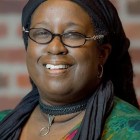
Don't Be Like Me: Jacqueline Patterson Breaks Her Silence on Intimate Partner Violence and the Shame That Keeps Black Women Quiet
In this deeply personal op-ed, Jacqueline Patterson, founder and executive director of The Chisholm Legacy Project, shares her experience as a survivor of intimate partner violence, reflects on the recent murders of Black women including Nancy Metayer and calls on Black women to break the silence and on communities to speak up when they sense something is wrong.

I am a survivor of intimate partner violence.
I don’t remember the hitting, likely due to a protective habit of leaving a blank space in my memory where a traumatic event occurred. My mind can’t conjure up images of a closed fist, about to strike. I do, however, remember the physical and emotional pain. I remember being very afraid and feeling helpless.
I remember the sensation of walking on eggshells. I remember being confident that it wasn’t my fault. I remember being deeply resolute that — as too many believe — the abuse wasn’t a sign of their intense love for me.
I remember knowing that I needed to get out and get away.
Yet what I remember most is the shame.
It was deep, isolating, soul-wrenching. It convinced me not to tell a living soul what was going on. It made me believe people would question my judgment if I spoke up. It told me that if anyone found out, I would be derided for letting myself fall into this situation.
Therefore, I confided in no one. Not family. Not friends. Not a counselor.
No one.
Haunted by ‘What-Ifs’
I was not alone. Approximately four in 10 Black women have experienced intimate partner violence in their lifetimes. Black women are more than twice as likely as white women to be murdered by their partner.
The past 30 days have laid bare that statistic, as the stories of Black women behind the data are told: Dr. Cerina Fairfax, Davonta Curtis, Pastor Tammy McCollum, Qualeshia “Sidditty” Barnes. It includes the horrific murder of eight young children in Louisiana and the wounding of the gunman’s wife — the mother of seven of the children — as well as his girlfriend.
It includes Nancy Metayer, an environmental scientist. Police officers checking on her well-being found her shot to death inside her home. Her husband has been charged with killing her.
Four years ago — the same year she was married — I interviewed Nancy for a role with The Chisholm Legacy Project; she was our top candidate. Since Nancy’s murder on April 1, I’ve been haunted by the what-ifs.
If Nancy had joined us, would I have seen something in her eyes — some telltale sign of abuse? Would I have heard something in her voice? Would I have seen through the mask that we, as victims, strive desperately to maintain while endeavoring to live long enough to become survivors? Would I have recognized my younger self in her?
Am I missing the signs in someone else right now?
Shame and Silence
I was 19 when I first experienced intimate partner violence. It wasn’t the last time. Each time, I dealt with it alone. And I escaped it alone.
A few people, like my mother, figured things out after the relationship ended. I know people suspected I’d been abused; for the observant, the signs are often there. But I also recall shutting down any attempt to get me to talk about it.
I must join the intrepid force of those who share their stories publicly. I want to tell someone in the cruel, stifling grip of IPV shame: don’t be like me.
Even as I write, I weep for the terrified young woman I was. I worked in a domestic violence shelter, and once harbored a friend fleeing her own abuser. Yet, I led a solitary, shadow existence of shame and fear. I never said to a close friend, “Here’s what’s going on with me. Can I talk to you?” I never asked a trusted relative, “Will you help me plan my escape?”
I now know it’s not enough to simply tell an intimate partner violence victim that the abuse is not their fault, that they should not bear the shame. Now, I must be the change I want to see in the world. I must join the intrepid force of those who share their stories publicly. I want to tell someone in the cruel, stifling grip of IPV shame: don’t be like me.
Tell someone. Get help. Get out. Your partner will not change. It will not get better.
To the friends, family members, and colleagues of victims: If you see something, say something. If you sense something, say something. Chances are, they are not okay — even if they insist that they are.
Do it even if it means angering that person because you forced them to face tough facts. Do it even if that person doesn’t talk to you for a while. It is far better than the alternative.
‘Hold Black Women’
The Black Femicide Prevention Coalition warns that Black women “are dying at rates that should alarm anyone claiming to care about Black women, the Black family, or the Black community. If people cannot address that reality directly, then they are not engaging in good faith and will be viewed as deflectors.”
And those deflectors “are avoiding the truth,” according to the coalition. “And the truth is that Black women and girls deserve more than deflection; they deserve urgency, honesty, and action.”
April 22 is Earth Day, set aside to honor and respect our planet. The Black women I know and work with are holding family, community, organizations, movement, democracy, and Earth care. We must ensure that we can hold ourselves. And we must ensure that the people and institutions around us know how to hold Black women, too.
This op-ed was originally published by Word in Black. For more information, visit www.wordinblack.com.