

A Perfect Storm for Small Business: R. Lynn Pingol on DEI Restrictions, DBE Rollbacks and the Federal Shocks Hitting Minnesota's BIPOC Entrepreneurs Hardest
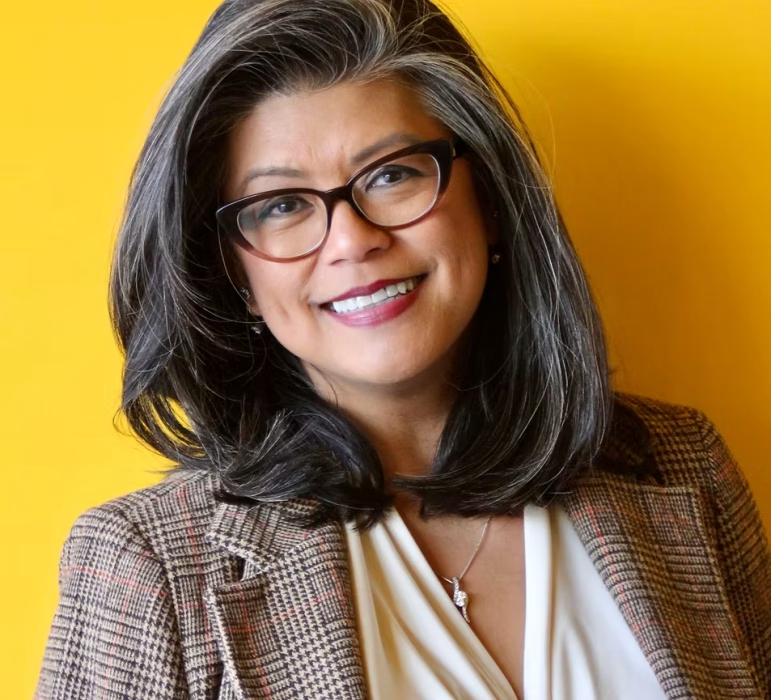
In this op-ed, Filipina-American entrepreneur and procurement expert R. Lynn Pingol argues that Minnesota's small businesses are facing a triple federal shock from DEI restrictions, DBE rollbacks and SBA 8(a) delays that is putting billions in revenue at risk and landing hardest on Black, immigrant and BIPOC-owned firms, and calls on the state to build infrastructure strong enough to withstand it.
Minnesota’s small-business community is facing a perfect storm. What began with Metro Surge, disrupting project timelines and destabilizing revenue for small contractors, has been compounded by a triple federal shock: DEI restrictions, DBE rollbacks, and SBA 8(a) delays. Together, these forces are creating pressure that is landing hardest on the communities that have historically had the least margin for disruption.
Minnesota is home to more than 550,000 small businesses, representing 99.5% of all firms and employing 1.3 million workers. But businesses with fewer than 10 employees, operating on thin margins, and owned by Black, immigrant, and BIPOC Minnesotans are absorbing the hardest blows.
Shock one: DEI restrictions
DEI-linked supplier-diversity programs supported more than 8,000 Black-, immigrant-, and BIPOC-owned firms statewide, connecting them to $300–$400 million in contracting opportunities annually. The new federal restrictions have eliminated those pipelines almost overnight by putting $120–$160 million in annual revenue at risk, driving certification delays up 30–40%, and leaving one in three BIPOC-owned firms without access to corporate or public-sector opportunities. For communities that fought decades for access, this is not symbolic. It is structural.
Shock two: DBE rollbacks
Minnesota has more than 1,500 DBE-eligible firms, nearly half located in the Twin Cities metro in North Minneapolis, Frogtown, the East Side, Brooklyn Park, and Brooklyn Center. Weakening DBE protections is projected to redirect $200–$350 million annually away from small and BIPOC-owned contractors, reduce DBE participation by 20–35%, and shrink apprenticeship pipelines by 15–20%. For a state already facing a construction workforce shortage, this is not just a setback, it is a structural risk.
Shock three: SBA 8(a) delays
Minnesota’s 8(a) firms, Black-owned engineering companies, immigrant-owned IT firms, small construction contractors, are reporting 60–90 day delays in federal contracting. That translates to $40–$60 million in delayed revenue annually, affecting 800–1,200 workers. With 40% of Minnesota small businesses holding less than one month of cash reserves, these delays are not survivable for many.
The pain is visible
This triple shock is visible block by block, on West Broadway in North Minneapolis, along Payne Avenue on St. Paul’s East Side, on Brooklyn Boulevard, and in business corridors from Rochester to St. Cloud to Worthington. Without action, Minnesota could see 8,000–12,000 permanent small-business closures, a $1.2–$1.8 billion reduction in statewide small-business revenue, and the erosion of generational wealth in communities that have historically been excluded from opportunity.
What Minnesota can do now
Minnesota cannot reverse federal policy, but it can build infrastructure strong enough to withstand it. That means creating a Small Business Access and Resilience Fund to replace lost federal technical-assistance dollars, expanding state and county contracting pipelines for BIPOC-owned firms, reinstating supplier-diversity engagement at the state level, protecting apprenticeship pipelines, stabilizing commercial corridors, and funding the culturally specific business organizations that have always done this work.
Minnesota’s Black, immigrant, and small-business communities have survived redlining, recession, and decades of disinvestment. They have rebuilt after every crisis. The question now is not whether they are resilient, they always have been. The question is whether Minnesota will match that resilience with action.
The decisions we make now will determine whether this perfect storm becomes a permanent setback, or the moment we chose to build something stronger.
R. Lynn Pingol is a Filipina-American entrepreneur and procurement expert who has supported more than 1,500 executives across industries, from startups to established firms.

Very well written.